BEGIN:VCALENDAR
VERSION:2.0
PRODID:-//jEvents 2.0 for Joomla//EN
CALSCALE:GREGORIAN
METHOD:PUBLISH
BEGIN:VTIMEZONE
TZID:Europe/Rome
BEGIN:STANDARD
DTSTART:20240324T163000
RDATE:20240331T030000
TZOFFSETFROM:+0200
TZOFFSETTO:+0100
TZNAME:Europe/Rome CET
END:STANDARD
BEGIN:STANDARD
DTSTART:20241027T020000
RDATE:20250330T030000
TZOFFSETFROM:+0200
TZOFFSETTO:+0100
TZNAME:Europe/Rome CET
END:STANDARD
BEGIN:STANDARD
DTSTART:20251026T020000
RDATE:20260329T030000
TZOFFSETFROM:+0200
TZOFFSETTO:+0100
TZNAME:Europe/Rome CET
END:STANDARD
BEGIN:STANDARD
DTSTART:20261025T020000
RDATE:20270328T030000
TZOFFSETFROM:+0200
TZOFFSETTO:+0100
TZNAME:Europe/Rome CET
END:STANDARD
BEGIN:STANDARD
DTSTART:20271031T020000
RDATE:20280326T030000
TZOFFSETFROM:+0200
TZOFFSETTO:+0100
TZNAME:Europe/Rome CET
END:STANDARD
BEGIN:STANDARD
DTSTART:20281029T020000
RDATE:20290325T030000
TZOFFSETFROM:+0200
TZOFFSETTO:+0100
TZNAME:Europe/Rome CET
END:STANDARD
BEGIN:STANDARD
DTSTART:20291028T020000
RDATE:20300331T030000
TZOFFSETFROM:+0200
TZOFFSETTO:+0100
TZNAME:Europe/Rome CET
END:STANDARD
BEGIN:STANDARD
DTSTART:20301027T020000
RDATE:20310330T030000
TZOFFSETFROM:+0200
TZOFFSETTO:+0100
TZNAME:Europe/Rome CET
END:STANDARD
BEGIN:STANDARD
DTSTART:20311026T020000
RDATE:20320328T030000
TZOFFSETFROM:+0200
TZOFFSETTO:+0100
TZNAME:Europe/Rome CET
END:STANDARD
BEGIN:DAYLIGHT
DTSTART:20240331T030000
RDATE:20241027T020000
TZOFFSETFROM:+0100
TZOFFSETTO:+0200
TZNAME:Europe/Rome CEST
END:DAYLIGHT
BEGIN:DAYLIGHT
DTSTART:20250330T030000
RDATE:20251026T020000
TZOFFSETFROM:+0100
TZOFFSETTO:+0200
TZNAME:Europe/Rome CEST
END:DAYLIGHT
BEGIN:DAYLIGHT
DTSTART:20260329T030000
RDATE:20261025T020000
TZOFFSETFROM:+0100
TZOFFSETTO:+0200
TZNAME:Europe/Rome CEST
END:DAYLIGHT
BEGIN:DAYLIGHT
DTSTART:20270328T030000
RDATE:20271031T020000
TZOFFSETFROM:+0100
TZOFFSETTO:+0200
TZNAME:Europe/Rome CEST
END:DAYLIGHT
BEGIN:DAYLIGHT
DTSTART:20280326T030000
RDATE:20281029T020000
TZOFFSETFROM:+0100
TZOFFSETTO:+0200
TZNAME:Europe/Rome CEST
END:DAYLIGHT
BEGIN:DAYLIGHT
DTSTART:20290325T030000
RDATE:20291028T020000
TZOFFSETFROM:+0100
TZOFFSETTO:+0200
TZNAME:Europe/Rome CEST
END:DAYLIGHT
BEGIN:DAYLIGHT
DTSTART:20300331T030000
RDATE:20301027T020000
TZOFFSETFROM:+0100
TZOFFSETTO:+0200
TZNAME:Europe/Rome CEST
END:DAYLIGHT
BEGIN:DAYLIGHT
DTSTART:20310330T030000
RDATE:20311026T020000
TZOFFSETFROM:+0100
TZOFFSETTO:+0200
TZNAME:Europe/Rome CEST
END:DAYLIGHT
END:VTIMEZONE
BEGIN:VEVENT
UID:fbf546fdb57ab0e80ab3f45846a97a0b
CATEGORIES:Seminari
CREATED:20250312T152126
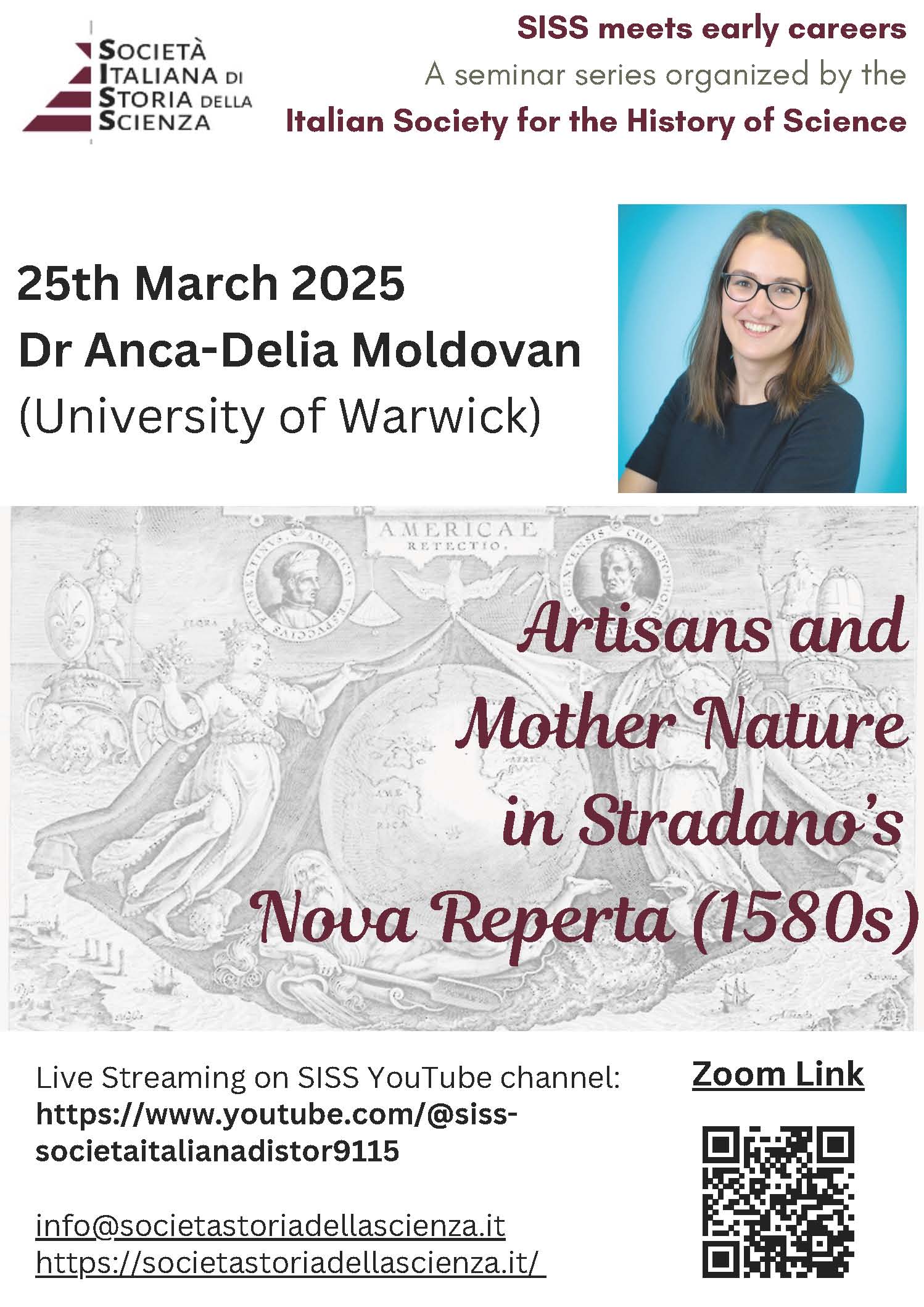
SUMMARY:Artisans and Mother Nature in Stradano’s Nova Reperta (1580s) di Anca-Delia Moldovan (University of Warwick)
DESCRIPTION:“SISS meets early careers”A seminar series organized by the Italian Society
for the History of Science\n2nd series 2025\n4.30pm CET25th March 2025Dr A
nca-Delia Moldovan (University of Warwick)\nTitle: Artisans and Mother Natu
re in Stradano’s Nova Reperta (1580s)\nAbstract: In the late 1580s, the Flo
rentine nobleman Luigi Alamanni commissioned the Flemish artist Jan van der
Straet, otherwise known as Giovanni Stradano, to design the Nova Reperta,
a series of nineteenth prints showcasing post-classical inventions and disc
overies. In this talk, I will examine what the Nova Reperta engravings can
tell one about the major sixteenth-century changes that governed the relati
onship between nature and human art. I will do so through the lens of the w
orkshop, which Stradano foregrounded in many of his prints. Workshops are m
ale-dominated spaces in which craftsmen, as alchemists, refine and bring na
ture to completion to the benefit of humanity: the wilderness is turned int
o cultivated lands; olives in oi; silkworms in silk; and plants in medicine
. The engravings display the superiority of modern Europeans both over nati
ve Americans and over the ancients. It was in the post-classical Florentine
and Netherlandish workshops that technologies, such as the mechanical cloc
k, the magnet, the compass, and the astrolabe, necessary to the navigation
of great distances, were developed, in the collaboration between artisans a
nd between artisans and the learned. Stradano personified the continent Ame
rica as a native Indian woman willingly surrendering herself to the rule of
art, technology, and catholic religion brought to its shores by the Floren
tine Vespucci. In doing so, Stradano depicted men imposing the order of art
upon the unruly creative forces of mother nature.\nBio: Anca-Delia Moldova
n is a Marie Sklodowska Curie Eutopia-SIF COFUND Fellow at the University o
f Warwick. She gained a PhD in History of Art from the University of Warwic
k (2020) having previously studied at the Universities of Florence and Buch
arest. She held fellowships at I Tatti, The Harvard Center for Italian Rena
issance Studies in Florence; Warburg Institute; Newberry Library; and Herzo
g August Bibliothek. Her work investigates calendrical and agricultural rep
resentations at the intersection of art, science, intellectual, and environ
mental histories in Early Modern Italy. Her current project examines the en
vironmental, artistic, and intellectual history of the olive tree in the Me
dici Grand Duchy of Tuscany. Moldovan published articles in the Rivista di
Storia della Miniatura; Renaissance and Reformation; and Renaissance Quarte
rly. Her forthcoming book Illustrating the Year: The Iconography of the Cal
endar and Its Cultural Impact in Early Modern Northern Italy was awarded a
Weiss-Brown Publication Subvention Award.\n\n
X-ALT-DESC;FMTTYPE=text/html:“SISS meets early careers”
A seminar series organized by the Italian Society fo
r the History of Science
2nd series 2025
4.30pm CET
25th March 2025
Dr Anca-Delia Moldovan (Un
iversity of Warwick)
Title: Artisans and Mother Nature in Stradano’s
Nova Reperta (1580s)
Abstract: In the late 1580s, the Florentine nobl
eman Luigi Alamanni commissioned the Flemish artist Jan van der Straet, oth
erwise known as Giovanni Stradano, to design the Nova Reperta, a series of
nineteenth prints showcasing post-classical inventions and discoveries. In
this talk, I will examine what the Nova Reperta engravings can tell one abo
ut the major sixteenth-century changes that governed the relationship betwe
en nature and human art. I will do so through the lens of the workshop, whi
ch Stradano foregrounded in many of his prints. Workshops are male-dominate
d spaces in which craftsmen, as alchemists, refine and bring nature to comp
letion to the benefit of humanity: the wilderness is turned into cultivated
lands; olives in oi; silkworms in silk; and plants in medicine. The engrav
ings display the superiority of modern Europeans both over native Americans
and over the ancients. It was in the post-classical Florentine and Netherl
andish workshops that technologies, such as the mechanical clock, the magne
t, the compass, and the astrolabe, necessary to the navigation of great dis
tances, were developed, in the collaboration between artisans and between a
rtisans and the learned. Stradano personified the continent America as a na
tive Indian woman willingly surrendering herself to the rule of art, techno
logy, and catholic religion brought to its shores by the Florentine Vespucc
i. In doing so, Stradano depicted men imposing the order of art upon the un
ruly creative forces of mother nature.
Bio: Anca-Delia Moldovan is a
Marie Sklodowska Curie Eutopia-SIF COFUND Fellow at the University of Warwi
ck. She gained a PhD in History of Art from the University of Warwick (2020
) having previously studied at the Universities of Florence and Bucharest.
She held fellowships at I Tatti, The Harvard Center for Italian Renaissance
Studies in Florence; Warburg Institute; Newberry Library; and Herzog Augus
t Bibliothek. Her work investigates calendrical and agricultural representa
tions at the intersection of art, science, intellectual, and environmental
histories in Early Modern Italy. Her current project examines the environme
ntal, artistic, and intellectual history of the olive tree in the Medici Gr
and Duchy of Tuscany. Moldovan published articles in the Rivista di Storia
della Miniatura; Renaissance and Reformation; and Renaissance Quarterly. He
r forthcoming book Illustrating the Year: The Iconography of the Calendar a
nd Its Cultural Impact in Early Modern Northern Italy was awarded a Weiss-B
rown Publication Subvention Award.
DTSTAMP:20260927T115820
DTSTART;TZID=Europe/Rome:20250325T163000
SEQUENCE:0
TRANSP:OPAQUE
END:VEVENT
END:VCALENDAR